
There is a moment every tech service provider knows well. You finish a complex server migration that took four hours but saved the client three weeks of downtime. If you charge by the hour, you look slow. If you charge by the project, you risk underpricing if the scope creeps. This tension between time and value is the core challenge in technology service pricing. Getting it wrong can turn a profitable contract into a money pit or drive away clients who fear unpredictable bills.
The choice isn't just about math; it's about psychology and risk allocation. When you pick a billing model, you are deciding who bears the risk of inefficiency and who captures the upside of speed. For concierge-style IT businesses, where trust and responsiveness are key, this decision shapes your entire brand reputation.
Understanding the Core Billing Models
Most technology firms operate within two primary frameworks: time-and-materials (T&M) and fixed-price projects. There is also a hybrid approach, often called capped time, which blends both. Each has distinct mechanics that affect cash flow and client perception.
Hourly Billing is a payment structure where clients pay for every unit of time spent on a task, typically tracked in 15-minute increments. It is transparent and flexible. If the client changes their mind, the bill adjusts accordingly. This model works best when the scope is undefined or likely to change, such as troubleshooting legacy systems or ongoing maintenance. The downside? Clients often view high hourly invoices with suspicion, assuming you didn't work efficiently.
Project-Based Pricing is a fixed fee agreed upon before work begins, covering all labor and materials for a defined scope. Here, the provider absorbs the risk of delays. If you finish early, you keep the margin. If you run long, you eat the cost. This model appeals to clients who want budget certainty. However, it requires precise scoping. A vague requirement like "improve website speed" is a disaster for fixed-price contracts because "speed" is subjective and hard to quantify without technical benchmarks.
Value-based pricing sits above these. Instead of charging for hours or deliverables, you price based on the outcome. Did the new CRM integration save the sales team 10 hours a week? Price the project relative to that savings. This is powerful but difficult to justify without clear data. It works best in B2B environments where ROI is easy to calculate.
Risk Allocation and Client Psychology
Why do clients resist hourly rates? It’s rarely about the total cost. It’s about control. When paying by the hour, clients feel they are renting your brain. They worry that if you take too long, you aren't good enough. In contrast, a fixed price feels like buying a product. The client pays for the result, not the effort. This psychological shift is crucial for building trust, especially in concierge services where the provider acts as an extension of the client's internal team.
Consider the risk matrix. In hourly billing, the client bears the efficiency risk. If your team is slow, the client pays more. In project billing, the provider bears the efficiency risk. If your estimates are off, your profit margin shrinks. Smart providers use this knowledge to guide clients. If a project has high uncertainty, propose hourly. If the scope is tight and well-defined, propose fixed price. Never let the client choose blindly. Educate them on why one model fits their specific situation better than the other.
For small business owners, who make up a large portion of tech service clients, predictability is king. They don't have finance departments to track variable costs. A $5,000 monthly retainer or a $12,000 fixed project fee is easier to approve than an open-ended hourly agreement. This is why many successful IT consultancies move toward subscription models or fixed-scope packages rather than pure hourly billing.
When to Use Hourly Rates
Hourly billing is not dead. It remains the standard for certain types of work. You should default to hourly rates in these scenarios:
- Unclear Scope: When the problem is diagnostic, such as "our network is slow," you cannot estimate a fixed price without spending time investigating first. Charge hourly for the diagnosis, then convert to a fixed quote for the solution.
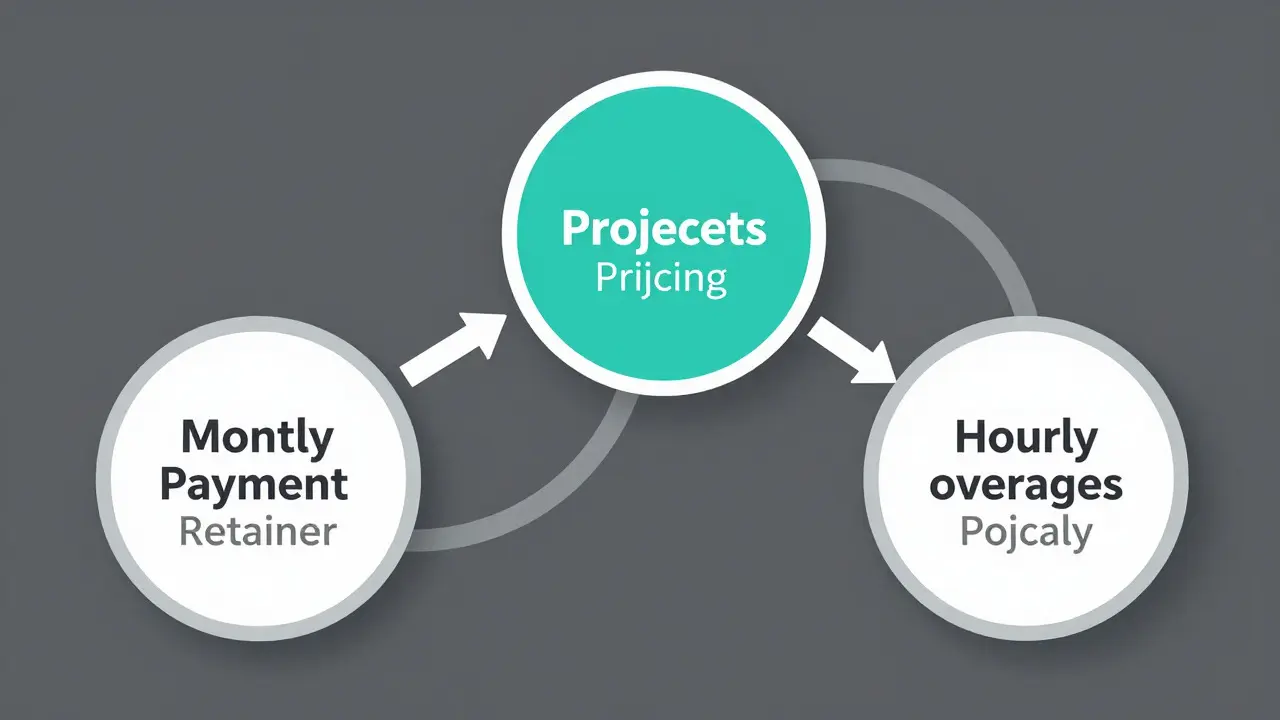
- Ongoing Maintenance: Managed Service Agreements (MSAs) often include a base monthly fee plus hourly overages for non-standard requests. This keeps the baseline predictable while allowing flexibility for edge cases.
- Client-Driven Changes: If the client frequently changes requirements, hourly billing protects you from absorbing the cost of rework. Every change request triggers a new invoice line item.
- New Relationships: When working with a new client, you lack historical data on their approval processes and communication styles. Hourly billing reduces the risk of misaligned expectations during the first few months.
The key to making hourly billing acceptable is transparency. Provide detailed timesheets. Break down tasks into granular descriptions. Instead of "IT Support - 4 hours," write "Troubleshoot DNS latency issues on primary server - 1.5 hours; Configure failover backup protocol - 2.5 hours." Specificity builds trust and reduces disputes.

When to Switch to Project Rates
Fixed pricing shines when you can define the boundaries clearly. The most common mistake providers make is trying to fix-price vague goals. To succeed with project rates, you need concrete deliverables. Ask yourself: Can I list exactly what will be done, what tools will be used, and what the final output looks like?
If the answer is yes, consider a fixed price. Examples include:
- Migrating 50 user mailboxes from Exchange to Microsoft 365.
- Implementing a specific cybersecurity audit with a predefined checklist.
- Developing a landing page with three sections and a contact form.
To set the right price, use bottom-up estimating. Break the project into small tasks. Estimate the hours for each task. Add a buffer for unknowns (typically 15-20%). Multiply by your fully loaded hourly rate (which includes overhead, taxes, and profit). Then, apply a risk multiplier based on the client's history. If they are known for scope creep, increase the buffer. This method ensures you don't accidentally subsidize the client's indecision.
| Feature | Hourly Billing | Project-Based Pricing |
|---|---|---|
| Risk Holder | Client | Provider |
| Budget Predictability | Low | High |
| Scope Flexibility | High | Low |
| Best For | Diagnostics, Maintenance, Unclear Needs | Defined Deliverables, Migrations, Development |
| Revenue Stability | Variable | Predictable per project |
| Client Perception | Cost Center | Investment/Product |
Hybrid Models and Retainers
In practice, few companies stick strictly to one model. The most sustainable revenue streams come from hybrid structures. A common setup for technology concierge services is a monthly retainer combined with project fees for major initiatives.
The retainer covers routine support, monitoring, and small fixes. It guarantees you a baseline income and gives the client peace of mind. Major projects, like implementing a new ERP system, are quoted separately as fixed-price engagements. This separation prevents routine noise from distorting the valuation of strategic work.
Another effective hybrid is the "capped hourly" model. You agree on a maximum number of hours per month. If the work exceeds that cap, the client approves additional hours at a premium rate. This caps the client's liability while protecting your margins. It works particularly well for startups that need IT support but cannot afford a full-time employee.
When structuring these deals, always define what is included and what is excluded. Ambiguity is the enemy of profitability. List out the top five most common tasks covered by the retainer. Anything outside that list triggers a separate quote. This clarity reduces friction and speeds up approvals.
Negotiation Tactics and Communication
How you present the price matters as much as the price itself. Never send a bare invoice or quote. Context sells. If you propose a $8,000 project, explain what happens if they don't do it. What is the cost of inaction? Frame the price against the value created, not the hours spent.
Use language that emphasizes outcomes. Instead of saying "We will spend 40 hours configuring servers," say "We will implement a redundant server architecture that ensures 99.9% uptime." The client cares about uptime, not configuration time. This shift in language justifies higher fixed prices because you are selling reliability, not labor.
During negotiations, listen for red flags. If a client insists on hourly billing for a clearly defined project, ask why. Often, they are afraid of being locked in. Reassure them with a change order process. Show them how easy it is to adjust the scope if needs change. Conversely, if a client wants a low fixed price for a vague scope, warn them about the risks. Sometimes, the best negotiation tactic is to advise the client to start with a paid discovery phase to clarify requirements before committing to a fixed price.
Common Pitfalls to Avoid
Even experienced providers fall into traps that erode profits. Be aware of these common mistakes:
- Underestimating Overhead: Your hourly rate must cover rent, software licenses, insurance, and admin time. If you only calculate direct labor, you are losing money on every job.
- Scope Creep in Fixed Deals: Without a formal change order process, clients will assume small tweaks are free. Document every change and its cost impact immediately.
- Discounting for Speed: Offering discounts to close a deal faster often attracts lower-quality clients who expect more for less. Focus on fit, not just speed.
- Ignoring Payment Terms: Net-30 terms can strain cash flow. For project work, aim for milestone payments (e.g., 30% upfront, 40% midway, 30% on completion). This aligns incentives and improves cash flow.
Regularly review your pricing strategy. Markets change. Labor costs rise. New technologies emerge. Annually, audit your past projects. Which ones were profitable? Which ones ate your time? Adjust your buffers and rates based on real data, not guesswork.
Final Thoughts on Choosing Your Model
There is no single correct way to price technology services. The right model depends on the client, the project, and your own risk tolerance. Start with hourly billing to build trust and gather data. As you understand the client's patterns and your own efficiency, transition to fixed-price projects for defined work. Use retainers to stabilize your revenue base.
The goal is not just to get paid, but to create a partnership where both sides feel the arrangement is fair. When you align your pricing model with the nature of the work, you reduce friction, improve margins, and position your firm as a strategic partner rather than just a vendor. That distinction is worth more than any single invoice.
Is hourly billing bad for tech companies?
No, hourly billing is not bad. It is essential for diagnostic work, maintenance, and projects with unclear scopes. The issue arises when it is used for well-defined projects where clients prefer budget certainty. Many successful firms use a mix of hourly and fixed pricing.
How do I calculate my fully loaded hourly rate?
Start with your desired annual salary. Add all business overheads (rent, software, insurance, marketing). Divide by the number of billable hours you expect to work in a year (usually 1,200-1,400 for consultants). This gives you a minimum rate to break even. Add your desired profit margin on top.
What is a reasonable buffer for project estimates?
A standard buffer is 15-20% for new clients or complex projects. For repeat clients with clear communication, 10% may suffice. The buffer accounts for unexpected technical issues, client delays, and minor scope adjustments. Always document assumptions so you can defend the estimate later.
Should I offer discounts for upfront payment?
Yes, offering a 5-10% discount for upfront payment can improve cash flow and signal confidence. However, ensure the discount doesn't devalue your work. Frame it as an incentive for convenience rather than a sign that your prices are negotiable.
How do I handle scope creep in fixed-price projects?
Define the scope clearly in the contract. Any request outside that scope requires a written change order. Agree on the process beforehand. When a change occurs, pause work, assess the impact, and present a revised quote. Most clients respect this process if it is applied consistently.